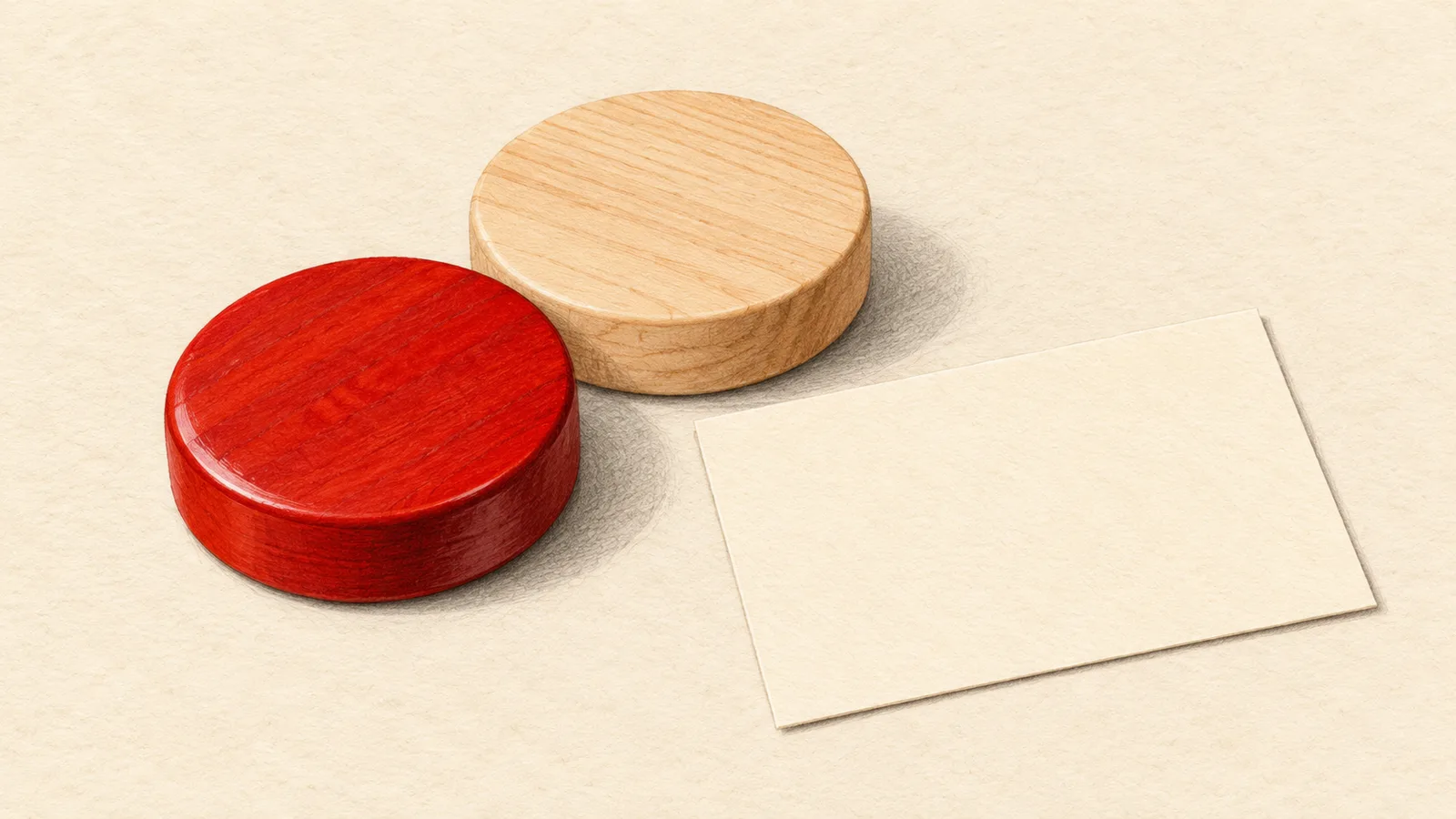
The Gubbi describes Collection 01 as natural lac colour on ivory wood, but that description does not establish a finished-product safety test. We do not claim food safety, child safety or toy certification: these are adult decorative objects. Not a toy, 14+.
The word “safe” needs a second question: safe for what use? A desk ornament, food-contact surface and children’s product ask different questions. This guide states the limits of our current information rather than treating a traditional material as a universal answer.
What the material description tells you
The collection’s shared description is hand-turned ivory wood (hale mara), friction-applied lac colour and laser marking. Our manufacturing brief explains colour being applied by pressing a lac stick against turning wood, with friction helping the transfer.
Those facts describe the making process. They do not tell you that a finished assembly has passed a particular laboratory test. They also do not establish the composition of every pigment, adhesive or other component in the final production sample.
The craft page and making article are useful for understanding the sequence. They should not be read as certificates.
What we do not claim
We do not call the objects non-toxic, food-safe, chew-safe, child-safe or certified toys. We have no published finished-product report supporting those descriptions. The terms explicitly say these decorative objects are not tested as toys.
We also do not turn the phrase “natural colour” into a promise about allergies or all kinds of skin contact. Those would be additional claims needing relevant evidence. The plain material description is the right place to stop with the information available.
This is why we do not use a check mark, a lab-style seal or a picture of a child in this guide’s image. Such visual shortcuts can make an unsupported claim even when the paragraph beside them is careful.
Read the intended use plainly
Bell Curve, with its steel ball, and the other collection pieces are decorative objects for adults. The age statement is “not a toy, 14+”. It does not mean the item is a tested children’s product for older children.
Keep the distinction when choosing a gift. A rounded shape or moving element does not change the declared use. Do not give one as a teether, a child’s handling object or an item intended for contact with food.
We are not giving a medical assessment of lac here. If your question concerns a reaction or exposure, a product description cannot supply an individual health answer.
The evidence we still need
For the actual batch, confirm the lac supplier, pigment composition and any additional finishes with the maker. Confirm assembly materials and how they differ between products. Keep that information tied to the sample and production batch rather than assuming every object from a place is identical.
If a safety claim is proposed later, it needs evidence suited to the exact claim and finished object. A document for a raw ingredient should not be described as a finished-product result. A report for another maker’s product should not be presented as ours.
The Channapatna visit can establish the material account and collect existing documentation. It cannot create a test result by photographing a lac stick. We will update this guide when there is specific evidence to add.
Care is a separate question
The product pages advise wiping with a dry, soft cloth and keeping pieces away from water and direct sun. Those are care instructions. They do not prove a safety classification or guarantee that a surface tolerates every cleaning product.
For more background, read what Channapatna means here. For hands-on making activities, Gubbi Art Club is our sister site; the materials and instructions for its workshops are separate from this collection.