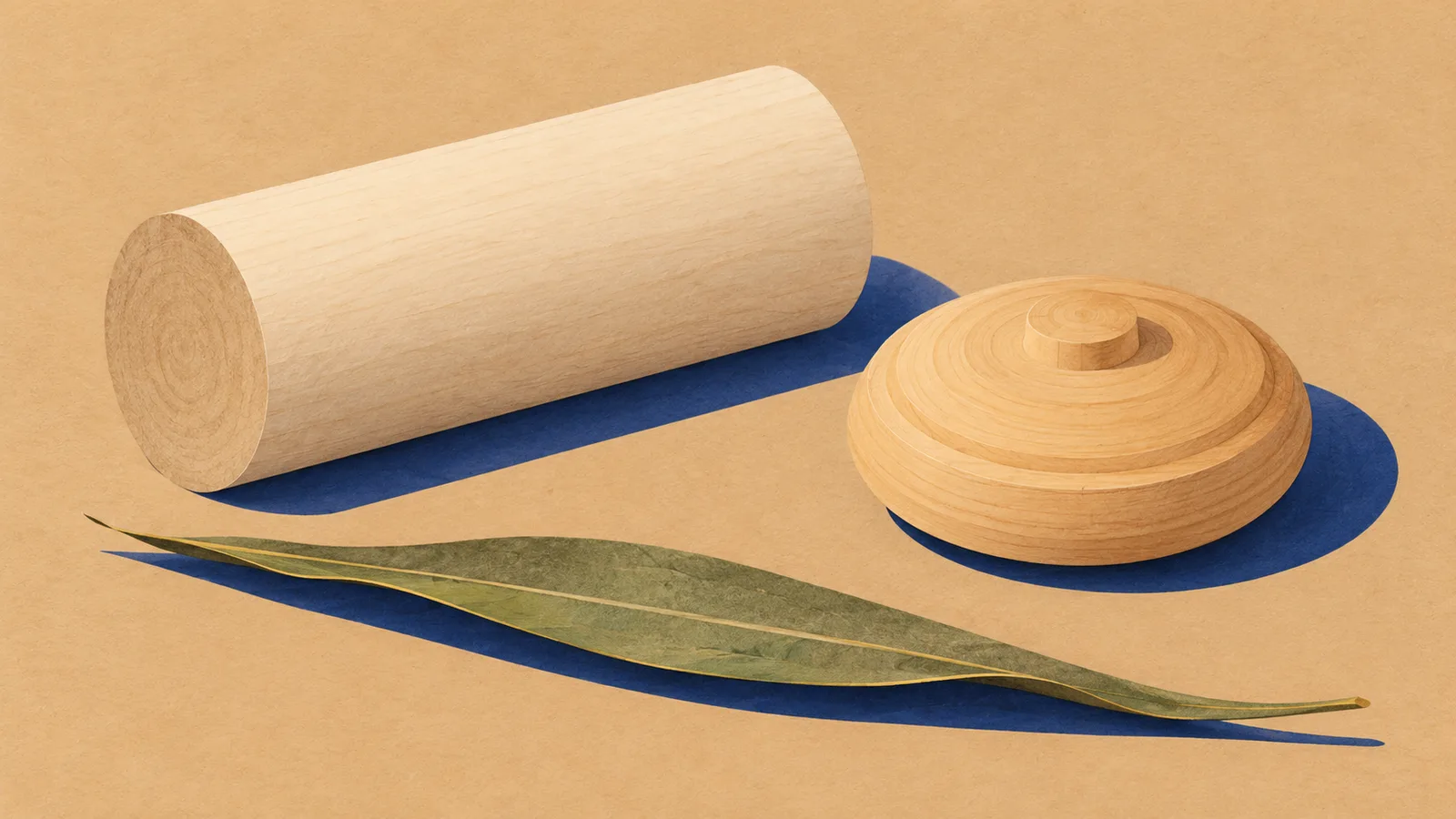
A Channapatna piece begins with seasoned wood, which is cut into blanks and shaped on a lathe. Lac colour is applied while the piece turns, then buffed with a leaf; an object with several components also needs assembly.
That is the core sequence behind Collection 01. It is easier to understand when we follow a component rather than pretend a whole prize wheel emerges from one cylinder. A turned post and a wheel built from six lacquered wedges do not ask for the same work.
The account below follows our manufacturing brief. The process images are illustrations, not photographs of makers producing our batch. We will replace the documentary gaps with permissioned photographs from the Channapatna visit. A useful explanation should let you tell those two kinds of image apart.
1. Season the wood
The collection material is ivory wood, called hale mara in our catalogue. Wood is seasoned before it is shaped. Our brief describes this as an early preparation stage, ahead of cutting, turning and colour.
There is no need to put a universal countdown beside it. The preparation of a particular batch belongs with the maker handling that wood. For the reader, the important distinction is that a cut log is not automatically ready to become a finished object.
When we photograph this stage, the cut ends and the way pieces are stored should be visible. A beautiful stack of anonymous timber is less useful than a photograph whose material and purpose have been confirmed.
2. Cut useful blanks
A blank is a rough piece sized for the next operation. Cylindrical blanks are a clear way to show what will happen on a lathe, but they are not the starting form of every component in the collection.
Our brief distinguishes turned parts from flat parts and parts needing lettering. That matters for Token Maxxer: base, post, wheel, hub and pointer are separate turnings, and the wheel is assembled from six lacquered wedges, rather than one large turning. Think in parts and the process stops sounding like magic.
At this stage, a designer needs to know which shapes belong to which operation. Fewer unnecessary parts can make a design easier to produce. That does not mean deleting the character. It means finding where its character actually lives.
3. Shape the turning piece
On a lathe, the wood spins while the maker uses a cutting tool to shape it. The spinning motion suits round forms. A wheel, a disc and a rounded body component each give that method something sensible to do.
Flat corners and box shapes require different decisions. Our manufacturing brief treats carving, joinery and bench work as separate operations. They should not disappear from the explanation because the word “lathe” sounds more romantic.
The lathe image remains a placeholder until we have a real photograph. For that photograph, hands, tool and spinning piece matter more than a dramatic face. The owner should photograph from a position the maker approves, without asking anyone to repeat a risky operation for the camera.
4. Apply lac colour
A stick of lac meets the turning wood. Friction helps it transfer onto the surface. This is the colour stage described in our craft page, and one of the useful details to look for in a real process sequence.
Our manufacturing brief lists red, yellow, orange, green, blue, black and brown in the natural lac palette. Bare wood is a separate material appearance. Samples, rather than a screen render, must establish the actual finish of a product.
Lettering is also a separate question. Pressing a lac stick onto spinning wood does not write a route name or a punchline. In Collection 01, names, marks and lettering are lasered after lacquering, often through the lac to the wood beneath. We do not imply that the colour operation does everything.
5. Polish with a leaf
The lacquered piece is buffed with a leaf. Earlier craft copy names a screwpine leaf; the manufacturing brief describes a dried palm leaf. We need the maker to confirm the exact leaf before presenting the species as settled.
Our current collection description names the wood, the friction-applied lac and the laser marking; it does not list a leaf polish, so treat this step as part of the broader craft until the maker confirms how it applies to our pieces. A close photograph should show the actual leaf contacting the actual piece. The object can be the subject of a still life, but the polishing photograph should document the action rather than merely put a leaf nearby.
After colour and polish, components need whatever assembly their design calls for. A nodding bot on a spring, four nesting dolls and a prize wheel do not share an identical assembly checklist. The broad craft sequence is useful; the final product is more specific.
What this means when you reserve
Handwork means small differences in grain, colour and finish. It does not excuse a chipped or cracked delivery. Our shipping and returns policy distinguishes normal variation from damage and explains how to contact us.
It also explains the current timing. Nothing is charged when you reserve. When your pieces are ready, we send a payment link and ask for your delivery address. Shipping cost and timing are confirmed in that email. A process story is not a delivery promise.
If you want to spend time with materials yourself, explore Gubbi Art Club. For the complete collection, meet all ten. You do not need to memorise the process to like one. Knowing it helps you ask better questions.