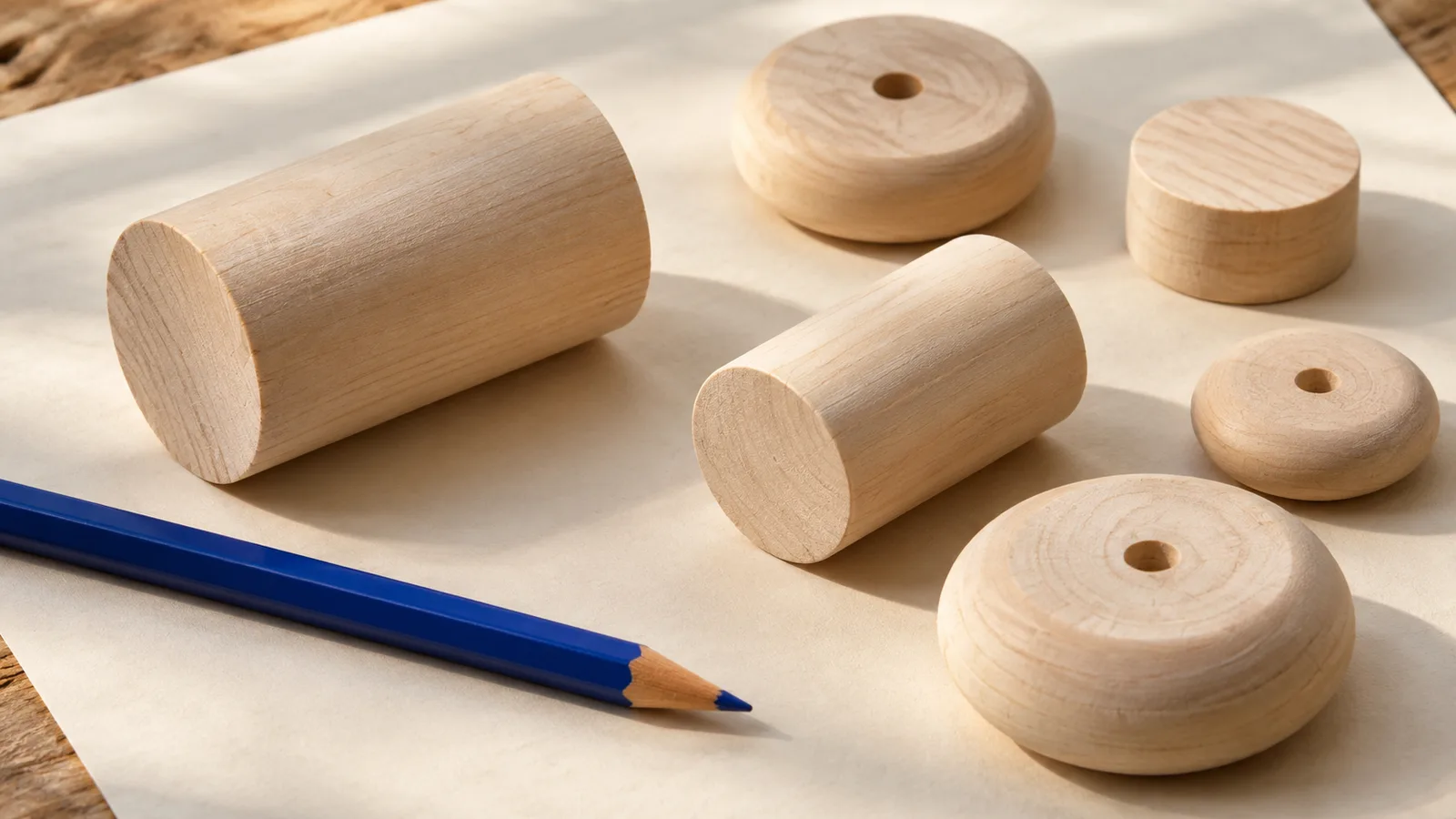
Channapatna is a place in Karnataka associated with a turned-wood craft. At The Gubbi, it is the craft behind Collection 01: hand-turned ivory wood, friction-applied lac colour and laser marking.
The short answer matters because the name can appear on a product without explaining much. What is the material? What work does the maker do? What makes the colour shine? A useful introduction should answer those questions before telling you how old or famous anything is.
Here, we start with the object. Look at its rounded parts, the grain visible in bare wood and the colour sitting on its surface. Those are better starting points than a grand claim about heritage. You can see what is being discussed. Then you can ask how it got there.
The wood comes first
Collection 01 uses ivory wood, named in our collection description as hale mara. This is wood, not animal ivory. Our manufacturing brief describes it as pale and soft, suited to the turning work at the heart of the craft.
The wood is seasoned before it becomes a component. It is then cut into manageable blanks. A blank is a rough starting piece, not an unfinished version of the whole character. An object with wheels, a body and a base can need several different components.
That distinction is useful when looking at a finished collectible. “Hand-turned” does not mean that every corner of a complicated object comes from one piece spinning on one machine. Turning, bench work and assembly can each have a role. We should say which work a part needs rather than make the process sound more mysterious than it is.
Round forms belong to the lathe
A lathe spins the wood while a maker shapes it with a cutting tool. Round parts suit that motion. Discs, wheels and rounded components are a natural place to begin a design.
Sharp corners ask a different question. Flat signs, a box shape or a small vehicle body can require other work. Our manufacturing brief treats those as design decisions, with parts considered separately. The craft is skilled. That does not mean it can turn any drawing into an object without changes.
For a designer, this is helpful resistance. A sketch may be funny but impossible to make consistently. A rounder part may keep the joke and suit the process better. The material has an opinion. Best to hear it before asking someone to make a batch.
Lac is part of the making
The colour comes from lac applied to the turning piece. Friction helps it transfer onto the wood. The finish is then buffed with a leaf. Our craft page lays out that sequence; each stage has its own job.
The palette in our manufacturing brief includes red, yellow, orange, green, blue, black and brown. Bare, polished wood has its own colour. A render with an attractive effect is not evidence that the same effect can be made with natural lac.
Nor does “natural” answer every safety question. Material identity and a test result are different things. If that is the question you came with, read the adult-use terms. We do not describe these objects as food-safe, child-safe or tested toys.
Old method, current subject
The Gubbi makes funny, contemporary objects with India’s traditional handcrafts. Channapatna is Collection 01, rather than the definition of the whole brand. Other Indian handcrafts belong in later collections; we have not named them here.
This first collection, Peak Bengaluru, looks at AI, office life and the city. Which Route puts the commute lottery on a desk. Deposit Box takes the ten-month advance. The point is recognition: someone sees an object and already knows whom it belongs to.
That is a design choice, not a claim that humour rescues an entire craft. A useful object still needs skilled making, workable production and honest information. A joke on its own cannot do those jobs.
How to read a listing
Look for the material, the place of making and the intended use. Ask what the pictured item represents and whether it is ready to buy. A workshop photograph should document a real workshop; an illustration should be identified as an illustration.
At present, The Gubbi accepts pre-orders without payment. A reservation is not a purchase and carries no obligation to buy. When pieces are ready, we write with a payment link and confirm shipping cost and timing. Read the reservation policy before choosing something for a fixed date.
For a different way into making, Gubbi Art Club is our sister site for art and craft workshops in Bengaluru. Keeping an object and making something yourself are two good reasons to pay attention to hands.